North and Mývatn Lake
Active volcanoes of Mývatn, whales of Húsavík and winter skies clearer than the south: the North concentrates Iceland's geothermal character far from the crowds of the Golden Circle.
Northern Iceland begins at Akureyri, the country's second city with around 20,000 inhabitants, nestled at the head of Eyjafjörður, Iceland's longest fjord. From our agency in Reykjavík, we send travelers there either by Route 1 (390 km, 5 to 6 hours via Borgarnes and the Hvalfjörður tunnel), or by a 45-minute domestic flight from Reykjavík. Akureyri concentrates most of the region's services: hospital, university, Nordic botanical garden, and genuine cultural life outside season, with its arts festival in August.
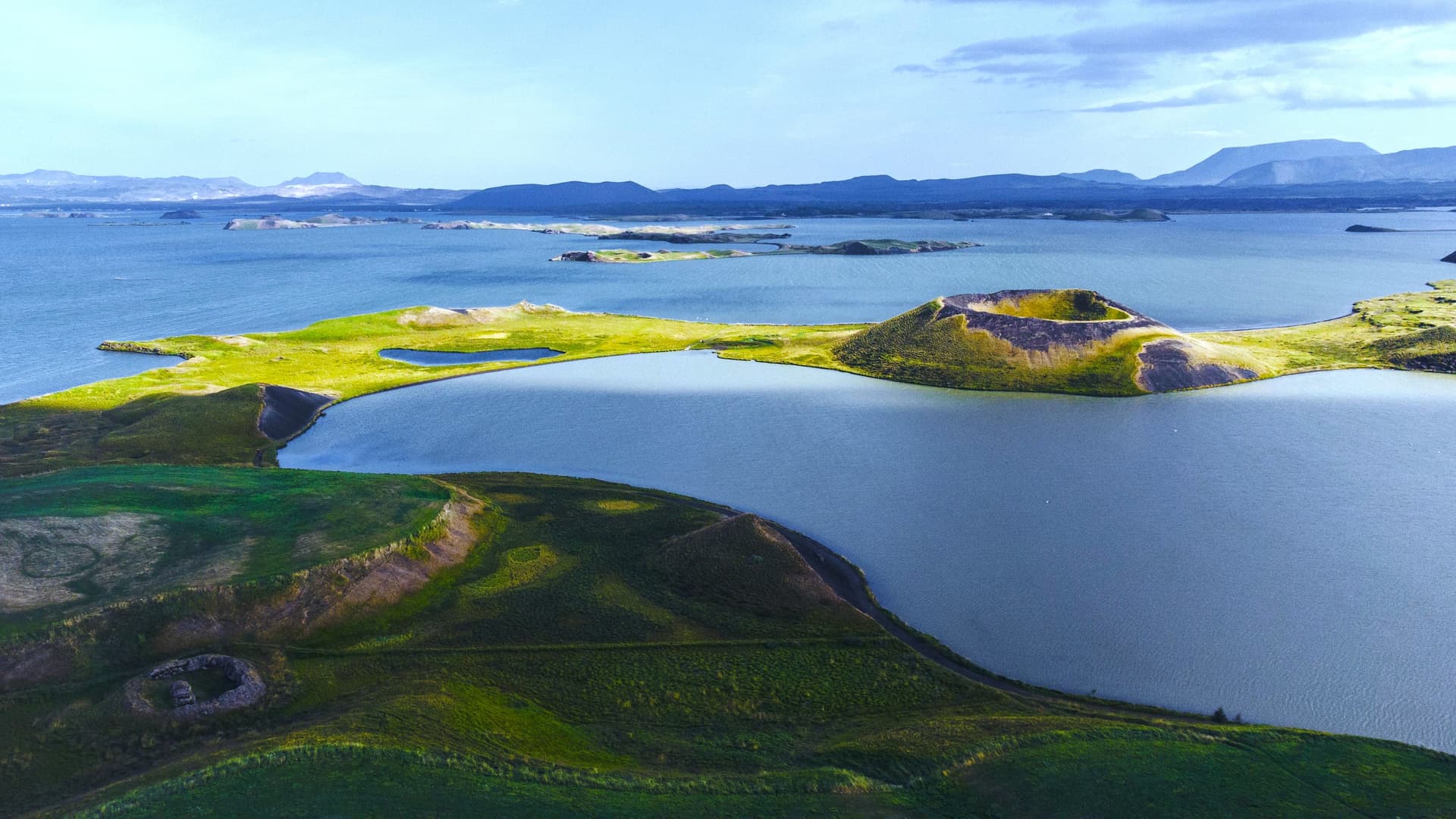
An hour's drive east on Route 1, you enter Mývatn's active volcanic zone. This shallow lake, formed 2,300 years ago by an eruption, is ringed by pseudo-craters at Skútustaðir, lava flows at Dimmuborgir and cones like Hverfjall. A few kilometers further, the Hverir geothermal site lines up mud pots and sulfurous fumaroles at 80–100°C on barren ochre ground. The Krafla volcanic system, which experienced nine eruptions between 1975 and 1984, now powers a geothermal power station open to visitors.
Further east, after a road crossing 30 km of stone desert, you reach Dettifoss, 100 meters wide and powerful at 500 m³ per second. It's the waterfall that feeds the Jökulsárgljúfur canyon, part of Vatnajökull National Park. Moving toward the coast, Ásbyrgi forms a horseshoe canyon bordered by 100-meter cliffs, covered in dwarf birches—a rarity in Iceland.
The north coast revolves around fishing and whale watching. Húsavík, a port of 2,300 people on Skjálfandi Bay, is our reference base for this activity: humpback whales, minke whales, occasionally blue whales, from June to August, with a success rate above 95% in high season. The Tröllaskagi peninsula, west of Akureyri, alternates narrow fjords and peaks of 1,200 to 1,500 meters. Its villages of Siglufjörður (herring museum, serious and well done) and Hofsós, a former Danish trading post, offer concrete insight into the history of coastal settlement.
The North also stands out for its climate. Protected from Atlantic depressions by the Vatnajökull ice cap and highlands, it receives two to three times less precipitation than the South. Winters are colder, down to -15°C or even -20°C in January inland, but the sky clears more often, making it highly favorable for northern lights viewing between late September and mid-March. For wildlife, the region concentrates the greatest diversity of waterfowl in the country around Mývatn: long-tailed duck, Barrow's goldeneye (endemic), more than fifteen nesting duck species.
Economically, the North lives off fishing, dairy farming in the Skagafjörður valleys, and more measured tourism than the South. It's still a region where you sleep in farm hotels, where geothermally heated municipal pools structure village life, and where hangikjöt (smoked lamb with dung) and harðfiskur (dried fish) remain everyday products rather than tourist curiosities.
To discover
Mývatn craters and solfataras. A full day among the pseudo-craters of Skútustaðir, the lava forest of Dimmuborgir and the ochre fumaroles of Hveiri, ending with a bath at Mývatn Nature Baths, the northern equivalent of the Blue Lagoon but at 40% of the price.
Whale watching from Húsavík. 3 hours at sea in Skjálfandi Bay from June to August, aboard former oak fishing boats converted for tourism. Humpback whales almost guaranteed, sometimes blue whales and orcas depending on the year.
Dettifoss and Ásbyrgi canyon. Europe's most powerful waterfall by discharge, followed 30 km north by a 3.5 km-long horseshoe canyon, a remnant of a catastrophic glacial flood 8,000 years ago.
Tröllaskagi coastal route. A 180 km loop via Dalvík, Ólafsfjörður and Siglufjörður, with single-lane tunnels, narrow fjords and a herring museum recounting the port's industrial heyday (1903–1968).
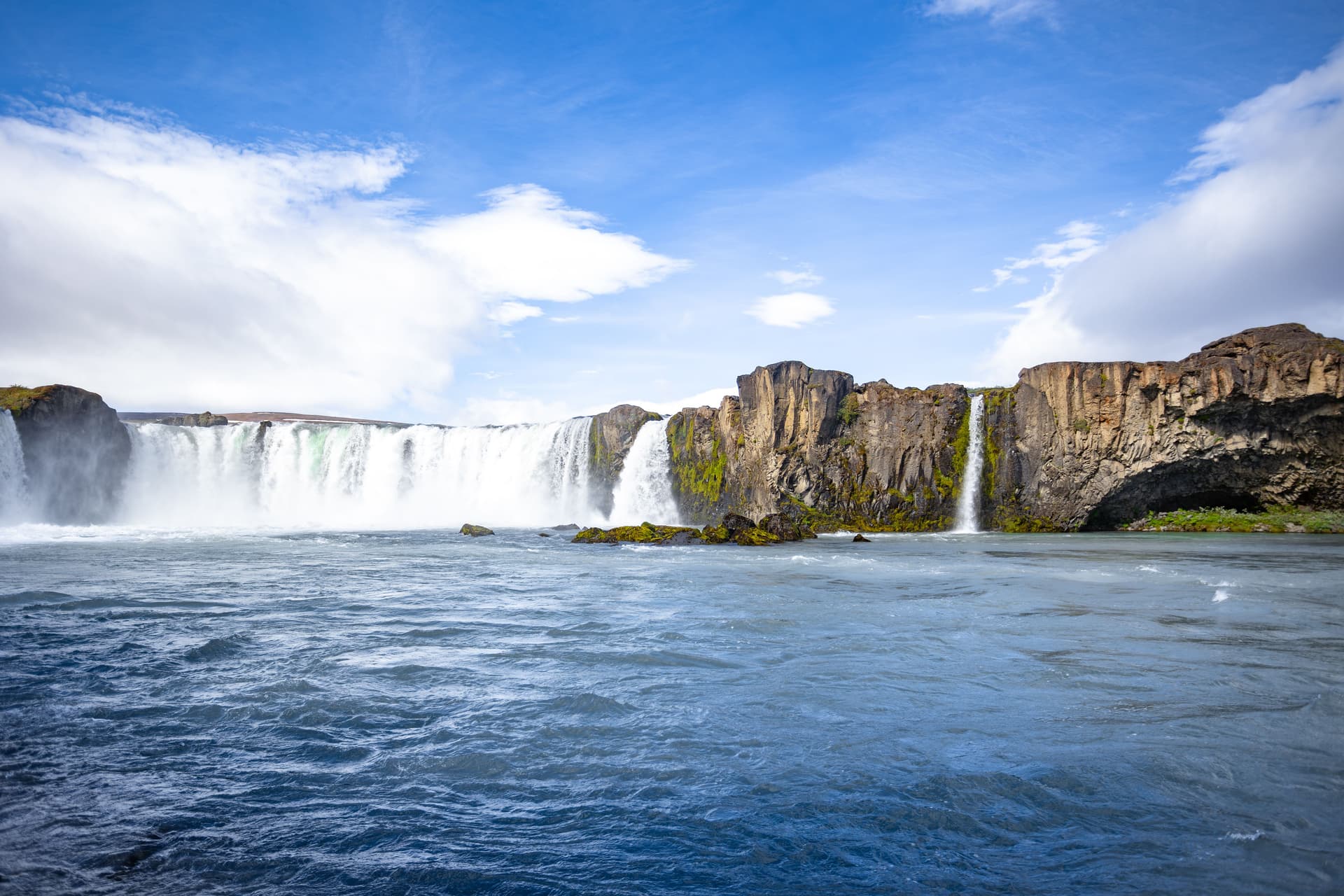
Northern lights above Goðafoss. The waterfall of the gods, 30 meters wide, under a winter sky often clear. Our team organizes guided vigils between October and March from farm hotels on Lake Ljósavatn, 40 minutes from Akureyri.
When to go
The best period for the North runs from mid-June to late August: daytime temperatures of 10 to 15°C, up to 20°C during warm spells, permanent daylight until late July, whales present in Skjálfandi Bay, and guaranteed access to secondary tracks around Krafla. September remains feasible (5 to 10°C) and marks the return of dark nights, so the first possible northern lights from mid-September onward. October sees secondary roads gradually closing, but Route 1 remains open year-round to Akureyri and Mývatn.
Winter, from November to March, is harsh but photogenic: -5 to -15°C on average, down to -20°C inland around Mývatn during Siberian cold waves. The North receives less precipitation than the South (around 500 mm/year versus 1,500 mm on the south coast), which explains more frequently clear skies and better northern lights viewing rates. April and May are transition months we recommend avoiding: roads still icy at altitude, whales not yet arrived, thaw landscapes unspectacular.
Practical advice
We recommend a minimum of 3 full days for the North: 1 day Akureyri and Goðafoss, 1 day Mývatn and Krafla, 1 day Húsavík–Dettifoss. To include Tröllaskagi or more remote areas of Vatnajökull National Park on the north side (Ásbyrgi, Hljóðaklettar), plan 5 to 6 days. The logistical entry point is Akureyri, accessible by direct flight from Reykjavík (45 min, several daily connections) or by Route 1 from the south.
The region combines naturally with the East Fjords via Route 1 toward Egilsstaðir (3 hours' drive, highland and fjord scenery), or with the West Fjords via the Tröllaskagi peninsula and a summer ferry from Sauðárkrókur. The North suits contemplatives, families (short, well-equipped sites around Mývatn), wildlife watchers and winter travelers who want to maximize their northern lights chances. Comfort ranges from rural guesthouses (simple rooms, shared bathrooms) to 4-star hotels in Akureyri. We primarily work with family farm hotels, more in keeping with the spirit of the region.