Luang Prabang
Luang Prabang
A UNESCO-listed former royal capital, Luang Prabang lines golden temples, colonial remnants and spectacular nature at the confluence of the Mekong.
Discovering Laos inevitably means visiting Luang Prabang. The capital of the province bearing its name, this city nestles in the heart of the country's northern region. It is renowned for its numerous Buddhist temples but also for its easygoing, invigorating and utterly unique atmosphere. For a true sense of escape, boat journeys on this "Mother of Waters" offer the chance to revel in both riverside and terrestrial landscapes. Beyond its status as the former national capital, Luang Prabang defines itself more as a land of many faces: colonial vestiges, monasteries and Buddhist rites, rural charm, lush vegetation, and much more.
A Brief History
The earliest traces of human habitation in Luang Prabang date back some 8,000 years before Christ. As far as records show, this city was the capital of the principality of Muong Xue, known as Xieng Thong Xieng before the 14th century.
It was not until 1353, following his exile in the Khmer kingdom, that King Fa Ngum unified the principalities and established the Kingdom of Lan Xang, or the Million Elephants. At that time, Xieng Thong Xieng held the status of capital. The name Luang Prabang appeared only in 1358, in honour of the Buddha statue Phra Bang. Already, we see the weight of Buddhist religion in the daily life of Laotians.
Its status as the capital of Laos was taken from it after King Setthathirath granted this honour to Vientiane around 1560.
In 1773, the Burmese of the Konbaung dynasty devastated the city to such an extent that a year later, the downtown area went up in flames. These initial plunders heralded a dark period for Luang Prabang. Indeed, the region experienced great instability toward the end of the 19th century: with raids by Chinese Black Flags in 1887 and occupation by Siamese troops.
What followed: the city was forced to accept the French protectorate in 1893, as was the case for the entire country. But out of affection for the royal city, the French rebuilt Luang Prabang with more modern infrastructure. They also expanded the Luang Prabang province and adorned it with beautiful colonial architecture.
After these turbulent periods, the nation turned toward new horizons, notably tourism in 1989. An economic turning point that contributed to Luang Prabang's growth and recovery. The classic and colonial architecture of its houses was restored for this purpose: charming hotels and guesthouses emerged and attracted increasingly more curious visitors and foreigners.
Luang Prabang: Then and Now
Turning toward the tourism sector allowed this Laotian city to revive its economy. Today, this former royal capital is an unmissable destination in Southeast Asia. It has opened to the international stage through the promotion of its natural and cultural heritage, and with the presence of its international airport. Allowing bars, restaurants and hotels of various standards to flourish has helped it gain appeal and accommodation capacity. This city where people sleep at 10 p.m. quickly became one of Laos' most tourist-friendly, most authentic and most prosperous provinces.
Luang Prabang is often called the pearl of Laos. At the same time, the city captivates many with its boat trips on the Mekong aboard a private vessel. This is ideal for exploring the depths of the Pak Ou caves inhabited by countless Buddha statues. This excursion is also nearly perfect for reaching traditional villages with their crafts, remote or otherwise, such as Ban Xang Hai and Ban Xang Khong. If desired, you can stay a night to experience local life and participate in handicraft activities.
For city center outings, nothing beats the bicycle and walking tours, especially since there are only a few kilometres to cover. This allows you to linger and take time to contemplate the beauty of the city, its temples and traditional houses.
For nature lovers, Luang Prabang has plenty to offer with its treks to meet the Hmong and Khmu peoples, or to reach Tad Sae or Kuang Si waterfalls with their azure and crystalline waters.
Preserved Identity and Heritage
In terms of culture, religion or history, Luang Prabang is undoubtedly one of Asia's most captivating cities. Listed as a UNESCO World Heritage Site since 1995, it has much to offer in terms of authenticity. There is indeed much to marvel at—its generous vegetation, its 33 imposing temples dedicated to Buddhist worship, its royal palaces and French architecture. Among the emblematic remnants of its heritage, we highlight:
· the royal palace built between 1904 and 1919, which became the seat of the National Museum since 1975: displaying a copy of the iconic Phra Bang Buddha statue
- the sublime Vat Mai monastery with its typically Luang Prabang features: former residence of the president of monks, patriarch of the Buddhist religion; exhibition site of the great emerald Buddha
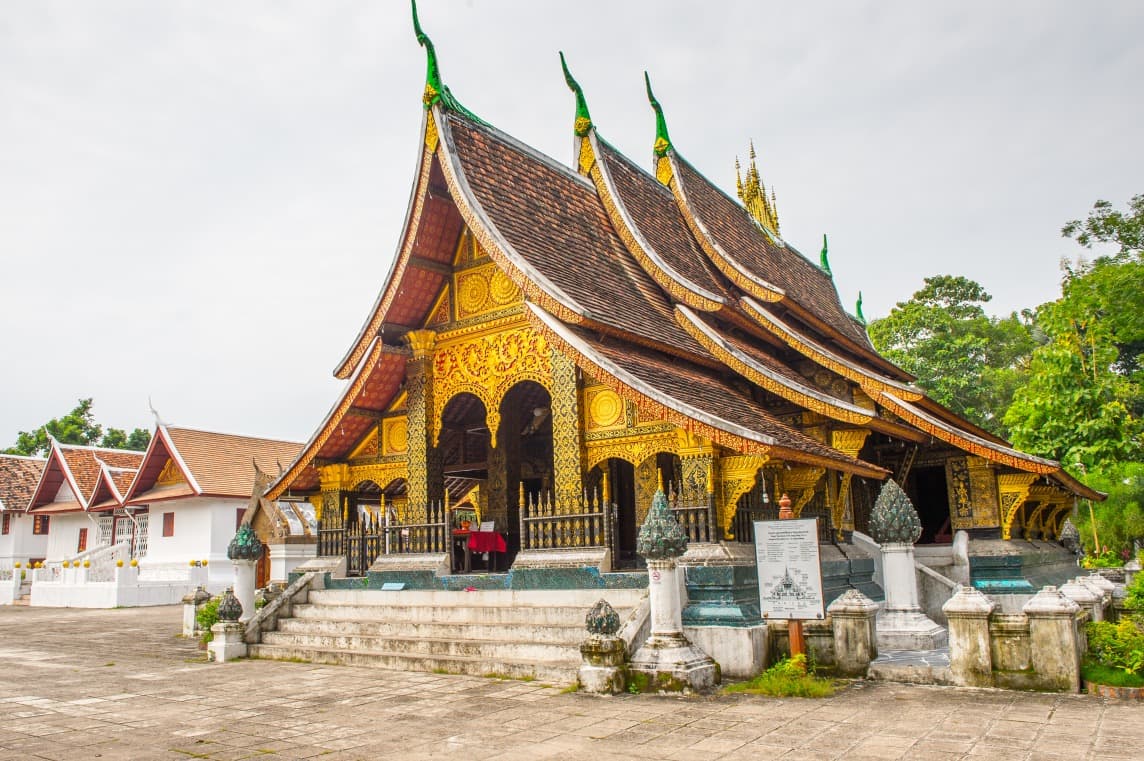
· the most beautiful sanctuary in Laos: the gilded Wat Xieng Thong
- the Vat Visoun built in 1450: the oldest monastery in this northern Laotian region
- the temple of peace Wat Phon Phao: with its painting collections
- Wat Long Khoun or the temple of happiness: for those seeking spiritual rejuvenation
Climate and Geography
Luang Prabang is situated at the confluence of the Nam Khan and Mekong rivers. A city in northwestern Laos, it nestles in the heart of a mountainous region at 700 metres altitude. Although cut off from any coastal horizon, it is nonetheless considered a peninsula on either side of its river banks. Indeed, it has a river port along the Mekong.
Regarding climate, this locality enjoys dry and wet seasons: very hot throughout the year in general; cold in December and January. If you plan to visit Luang Prabang, mark October through March on your calendar to fully enjoy the region. The best periods remain March and November: gentle sun and refreshing occasional showers. Otherwise, you'll encounter heavy rainfall and intense heat. On average, the city receives annual rainfall of 1,450 millimetres.
To reach Luang Prabang, three options exist:
· by plane: the ideal would be to arrive by air from major Asian countries such as Bangkok, Singapore, Hanoi or China. Its airport is located 4 kilometres from the city center.
- by boat: from Vientiane, a river cruise through the Mekong allows you to not only enjoy genuine travel comfort but also benefit from the scenery. For tight budgets, more modest vessels are available.
· by bus: Luang Prabang is accessible by road from the capital. The journey offers less comfort and takes longer (no less than 4 hours).
In Luang Prabang, few cars travel the roads. Because of this, people find real appeal in enjoying a walking tour in the middle of the street. It is quite pleasant and ideal for strolling and admiring the surroundings.
And for those who prefer two or four-wheeled vehicles, they can choose and negotiate for:
- the tuk tuk: practical, safe and fast but expensive
· the taxi: comfortable and quick
· the bicycle: perfect for exploring here and there through the city center
What to Do?
· wake up to the sound of monks' gongs resonating through the city for the alms collection
· visit rustic houses and temples in old Luang Prabang
· stroll through the city streets on foot, by bicycle or tuk tuk
- climb the 300 steps of Phousi Mount to savour the superb view
· attend the water festival "Pimai" during the Laotian new year for those visiting in mid-April
· take a dip beneath the waters of the Kuang Si waterfall or Tad Sae cascade
· bring joy to children by donating books to the city center library
· try your hand at organic farming and learn rice cultivation at Living Land Company farm
· discover the region's ethnic roots at the Luang Prabang Centre for Traditional Arts and Ethnology
- participate in various workshops: traditional crossbow or bow-making with a Hmong hunting expert; homemade flute crafting; wine-making initiation; learning traditional Lao weaving at Ban Phanom; working with soft and metal materials to create bladed weapons and agricultural tools; wood carving under the guidance of a former artisan from the country's royal family
· immerse yourself in Lao life through a gastronomic experience within a local family
- participate in the Buddhist alms-giving ceremony
- visit the elephant sanctuary and seize the chance for a ride on these magnificent creatures
· venture into the caves of Nong Khiau and Pak Ou (where hundreds of Buddhas are housed)
Want to discover this destination?
Our local advisors design your tailor-made trip.