Vientiane and Central Laos
A capital with the rhythm of a riverside town on the Mekong, the megalithic plateau of Xieng Khouang and a pirogue crossing through the Konglor cave in the Khammouane karst.
Vientiane remains one of Southeast Asia's most understated capitals. Perched on the left bank of the Mekong, facing Nong Khai in Thailand, the city retains the character of a large administrative town where buildings rarely exceed six storeys. Each morning, the monks of Wat Si Muang still collect alms along Setthathirath Street, and civil servants lunch on khao piak sen, a thick rice noodle soup with chicken, in the stalls of Khua Din market. Our agency is based here, just streets away from Patuxai, and each year we watch the city slowly transform without losing the unhurried pace that sets it apart from Bangkok or Hanoi.
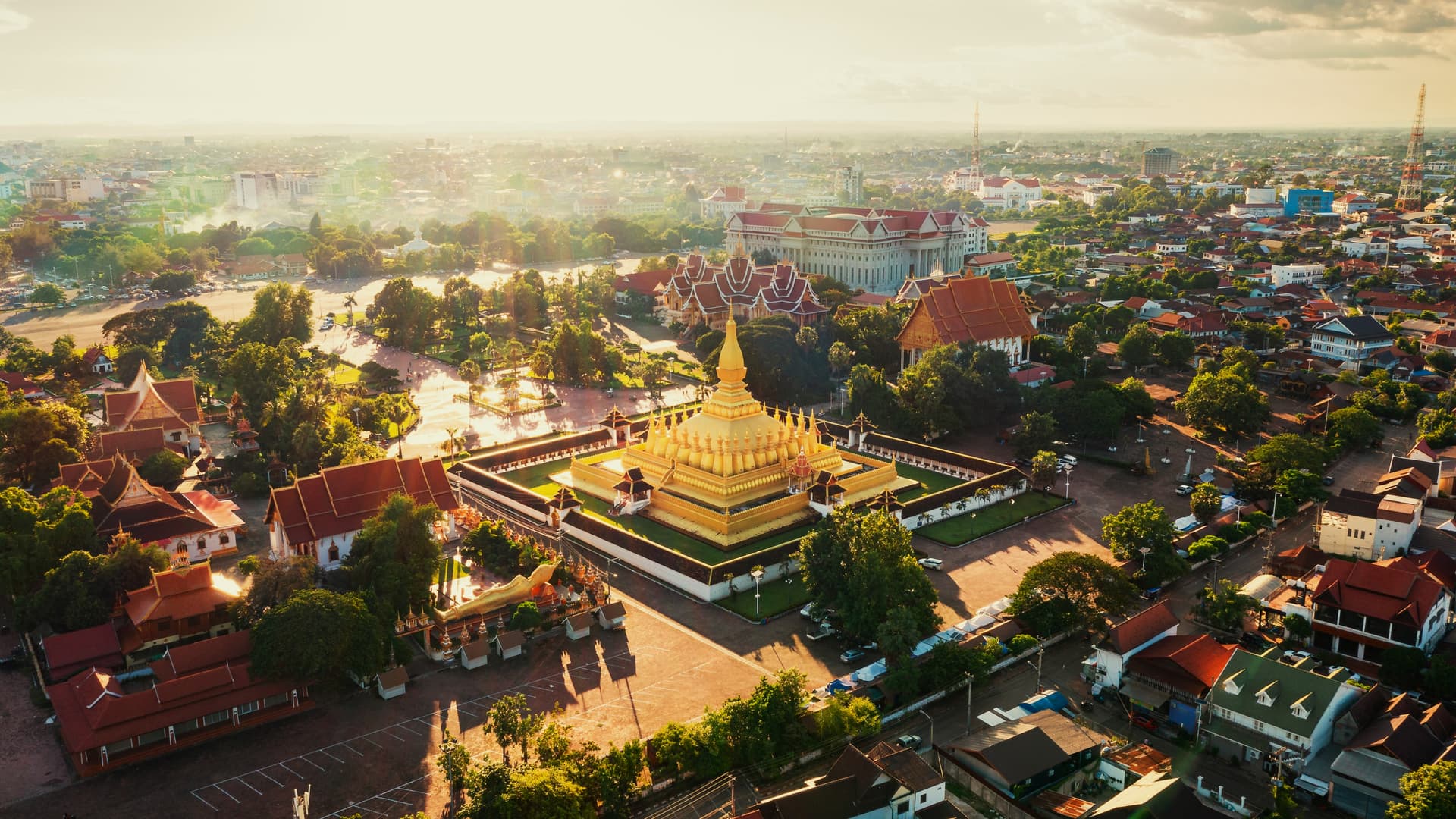
The historic centre spans just a few square kilometres. The Pha That Luang, a golden stupa rebuilt in the 16th century under King Setthathirath, serves as a national symbol and hosts the Boun That Luang in November, one of the country's most widely observed religious festivals. Nearby, Wat Sisaket, completed in 1824, is the only temple to survive the Siamese sack of 1828: its cloisters shelter nearly 7,000 Buddha statues lined up in wall niches. The Haw Phra Kaew, a former royal temple that once housed the Emerald Buddha before its transfer to Bangkok, rounds out a half-day of exploration. As evening falls, the Mekong banks come alive around Chao Anouvong night market, where you can eat tam mak hoong, a salad of pounded green papaya.
East of Vientiane stretches Khammouane province, a karst kingdom still off the beaten path. The town of Thakhek, on the Mekong, serves as the starting point for the loop circuit of the same name, a roughly 450-kilometre route through limestone cliffs, rice paddies and Lao Loum villages. The highlight of the loop is Konglor cave: you traverse it by motorised pirogue for 7.5 kilometres under a vault that reaches 100 metres in height at its highest points. On the exit side, the village of Ban Natane still lives from tobacco and sticky rice cultivation. Further south, Hin Nam No National Park, inscribed as a UNESCO World Heritage site in 2025, extends the Vietnamese karst massif of Phong Nha-Ke Bang.
Northeast of the capital, Xieng Khouang province occupies a mid-altitude plateau, between 1,000 and 1,200 metres. Phonsavan, its provincial capital rebuilt after 1975, provides access to the Plain of Jars, a set of over 90 archaeological sites where hundreds of sandstone jars, carved between 500 BC and 500 AD, rest in the grasslands. Sites 1, 2 and 3 have been demined and opened to the public. The province also bears the marks of the secret war conducted by the CIA between 1964 and 1973: more than two million tonnes of bombs were dropped on Laos, and demining work continues. The MAG (Mines Advisory Group) information centre in Phonsavan offers insight into the scale of the problem.
Central Laos is also home to ethnic minorities found nowhere else in the country. Around Xieng Khouang live Hmong and Khmou communities, whose weekly markets at Muang Khoun or Nong Het are worth a detour. In Khammouane, the Brou and Makong still inhabit hamlets along the Nam Hin Boun. Local cuisine gives special place to game, bamboo shoots and or lam, a thick stew made with bitter aubergines and dried buffalo skin, the emblematic dish of Xieng Khouang.
This central region thus offers a rare contrast within Laos: a river capital, a plateau shaped by recent history, and a karst massif still on the margins of major tourist circuits. The climate is warmer than in Luang Prabang during the cool season, but nights in Xieng Khouang can drop below 10°C in January.
To Discover
Pirogue crossing through Konglor cave. 7.5 kilometres of navigation beneath a limestone vault that rises to 100 metres, from the village of Ban Konglor in Khammouane. The exit opens onto a steep valley inhabited by Lao Theung.
Plain of Jars at Phonsavan. Three accessible archaeological sites around Phonsavan, where hundreds of megalithic sandstone jars, 2,000 to 2,500 years old, scatter across the plateau grasslands. Unexploded bombs from the American war are still marked outside designated safe zones.
Pha That Luang and Wat Sisaket in Vientiane. The golden stupa symbol of the nation and the capital's oldest remaining temple, with its 7,000 Buddha statues in the cloisters. A half-day on foot through the historic quarter is enough to visit both.
Thakhek loop by motorbike or car. A three to four-day circuit through Khammouane, among karst cliffs, reservoir lakes and Brou villages. A still little-travelled itinerary, best done from November to March to avoid muddy tracks.
Vientiane morning market on the Mekong. Give alms to monks at 6am in the centre streets, then breakfast on foe (rice noodle soup) facing the river, with Thailand on the opposite bank.
When to Go
The best time to visit Vientiane and central Laos runs from November to February: clear skies, low humidity, daytime temperatures around 25 to 28°C in Vientiane and Khammouane. On the Xieng Khouang plateau, expect 18 to 22°C by day but nights regularly dropping below 10°C in December and January, sometimes as low as 3 or 4°C: bring a fleece. March to May is the hot season, with peaks reaching 38°C in Vientiane and Thakhek, and agricultural fire haze reducing visibility, especially in April.
Monsoon season runs from June to September. Rainfall is intense in Khammouane (up to 300 mm in August), the Thakhek loop tracks become difficult, and some sections of Konglor cave close during floods. However, the karst landscapes are then saturated green and visitor numbers very low. October marks the end of monsoon and remains a good month to see flooded rice paddies before harvest.
Practical Advice
Allow a minimum of four to five days for central Laos: two days in Vientiane, including a half-day for temples and one day for the Xieng Khouan Buddhist park 25 kilometres south, then three days for the Thakhek loop and Konglor, or three days in Xieng Khouang. To combine Plain of Jars and Khammouane, plan for seven to eight days. Wattay International Airport in Vientiane is the logical entry point, with daily flights from Bangkok, Hanoi and Singapore. Phonsavan also has a small airport connected to the capital by a 35-minute flight, avoiding the 10-hour winding drive.
The region combines well with Luang Prabang and the North (one-hour direct flight from Vientiane) for a 12 to 14-day cultural journey, or with the Boloven Plateau and Si Phan Don in the south for travellers moving down the country over three weeks. Hotel comfort is good in Vientiane (4 and 5-star establishments), adequate in Phonsavan and Thakhek (3-star maximum), and more rustic at Konglor where we work with village guesthouses. This region suits travellers curious about recent history, lovers of karst landscapes, and those wanting to see a Laos less frequented than the northern Mekong valley.