The midnight sun phenomenon in Iceland: where and when to observe it?
While Iceland's winter sky promises wonders with the appearance of the northern lights, summer brings an entirely different atmosphere!
While Iceland's winter sky promises wonders with the appearance of the northern lights; summer brings an entirely different atmosphere! For several days, a natural phenomenon unfolds and offers nearly endless days. This is what we call the midnight sun, a period during which the sun never sets… Where and when can you observe the midnight sun phenomenon in Iceland? We tell you everything!
What is the midnight sun?
Also known as the polar day, the midnight sun is a natural phenomenon during which the sun never sets! Although it descends, the sun does not disappear below the horizon and remains suspended even at its lowest point of the day. After midnight, it slowly rises again and offers a new day without night! This weather phenomenon occurs every year as the summer solstice approaches, north of the Arctic Circle as well as south of the Antarctic Circle. The closer you are to the pole, the better your chances of witnessing the midnight sun.
Where to observe the midnight sun phenomenon in Iceland?
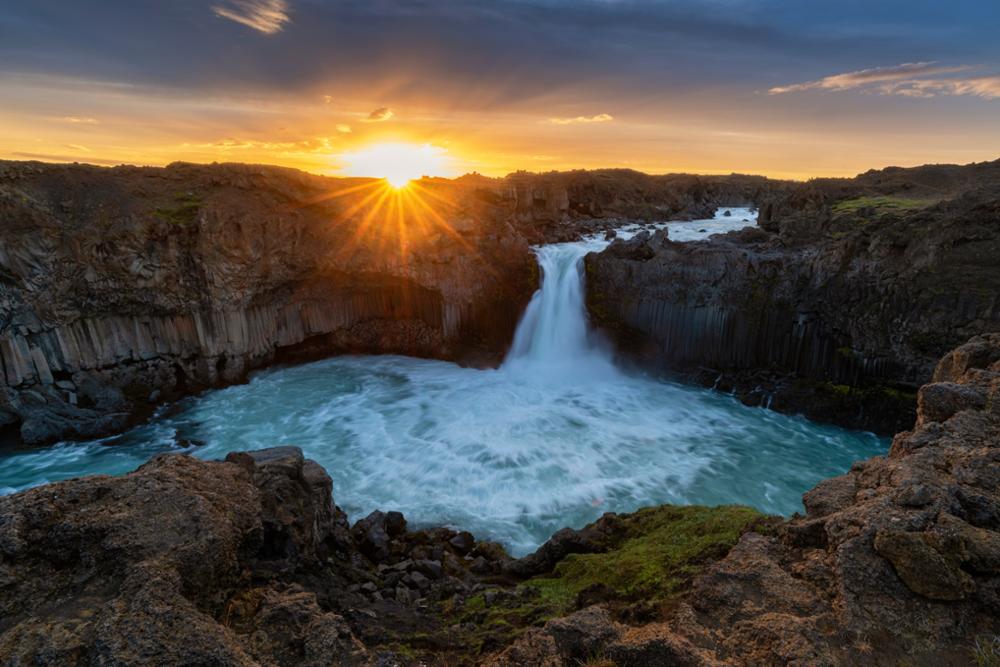
As we mentioned, the midnight sun is a phenomenon observed above the polar circle. However, Iceland is not entirely located within the Arctic Circle. Only a small Icelandic island is actually crossed by the polar circle. This is Grímsey island. Located in the country's far north, 40 km off the Icelandic coast, this island proves to be the ideal place to observe the midnight sun phenomenon in Iceland! Many excursions are organized to take you to the island during the summer solstice.
Of course, white nights are present throughout the country, but the spectacle is less impressive there than on Grímsey, since here you can almost see the sun bouncing off the horizon line! That said, other sites are also highly appreciated for the beauty of their landscapes and the incredible light created by the midnight sun phenomenon. This is the case with Husavik, Rauðinúpur, Latrabjarg, Hornstrandir, Rif, Hellisandur, and Stykkisholmur... One thing is certain: it's time to bring out your cameras to capture this magical moment!
When to observe the midnight sun phenomenon in Iceland?
In Iceland, the white nights last approximately three months. They begin about one month before the summer solstice, which occurs on June 21, and continue for one month after. During this period, the days are longer and the sun sets for only a few hours. The closer you get to June 21, the shorter the nights become, or even disappear entirely. The period between June 18 and 26 therefore proves to be the perfect time to experience several days without night!
Frequently asked questions
The midnight sun, also called polar day, is a natural phenomenon during which the sun does not set completely. It remains suspended above the horizon even at its lowest point, providing continuous light over 24 hours. In Iceland, this phenomenon is particularly visible around the summer solstice, June 21.
The midnight sun in Iceland is observed primarily between mid-May and mid-July, the white nights period. The ideal window falls between June 18 and 26, around the summer solstice (June 21), when nights are shortest or even non-existent.
The best place to observe the midnight sun in Iceland is Grímsey island, located 40 km off the northern coast of the country. It is the only part of Iceland crossed by the Arctic polar circle. Other sites such as Husavik, Latrabjarg, or Hornstrandir also offer magnificent viewpoints.
Grímsey island is accessible from Akureyri, the major city in northern Iceland, by ferry (approximately 3 hours) or by domestic flight (approximately 30 minutes). Organized excursions are available, particularly during the summer solstice, to fully experience the midnight sun.
To sleep well during white nights in Iceland, it is advised to bring a sleep mask and arrange for blackout curtains or check that your accommodation is equipped with them. Some travelers also choose to adapt their sleep schedule to make the most of the nighttime light.