Eldhraun
Eldhraun
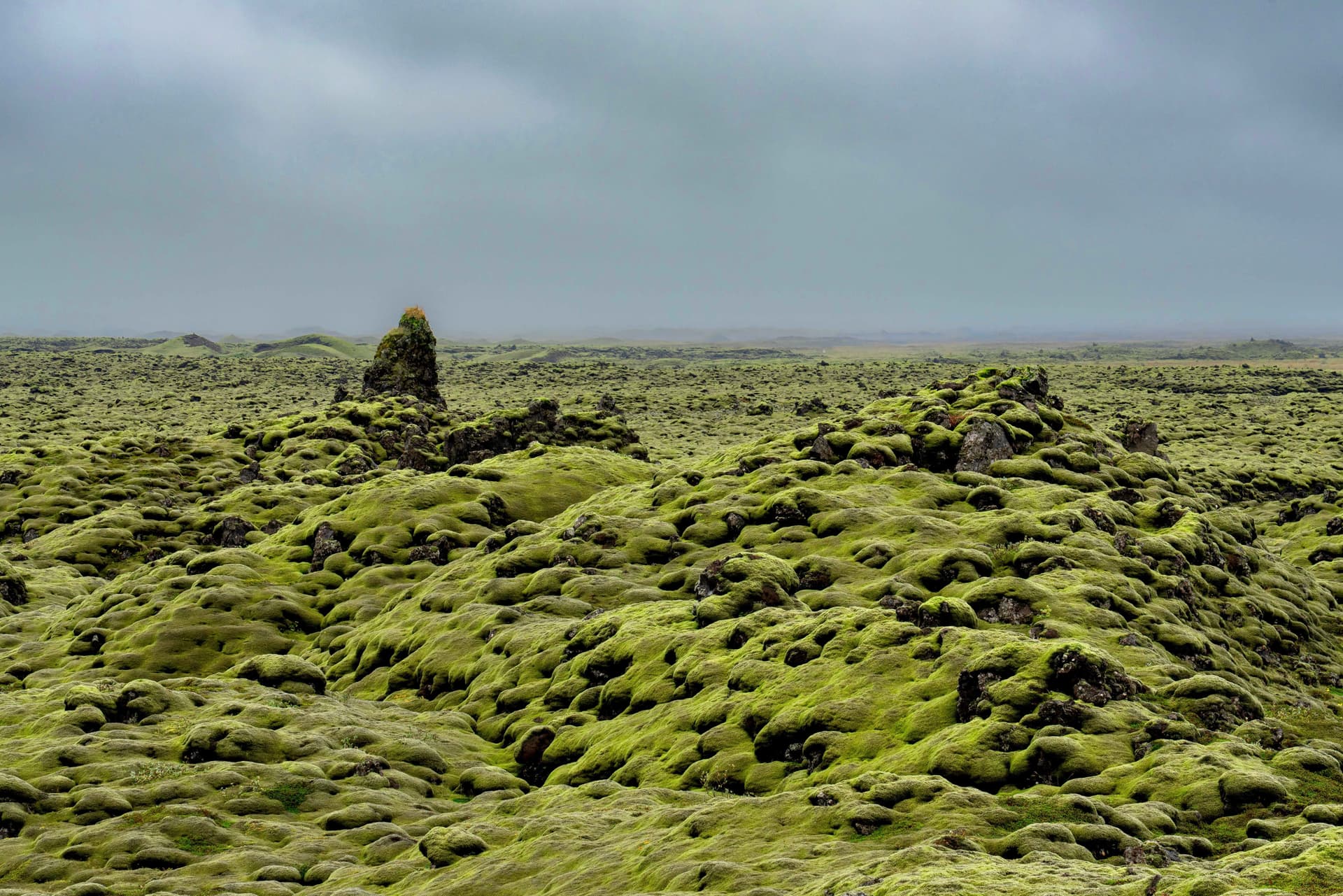
Born from the catastrophic Laki eruption in 1783, Eldhraun is a 565 km² lava field entirely carpeted in green moss, stretching along Route 1 between Kirkjubæjarklaustur and Vík.
Eldhraun is a moss-covered lava field spanning approximately 565 km² in south Iceland, between Kirkjubæjarklaustur and Vík. Born from the Laki eruption of 1783–1784 — one of the most devastating in modern history — it ranks among the world's largest basaltic lava fields. Its surface entirely blanketed in vibrant green moss gives it an almost surreal texture, hovering between lunar landscape and miniature forest.
Practical Information at a Glance
- Access: Visible from Route 1 (Ring Road), between Kirkjubæjarklaustur and Vík — no ticket required.
- Admission: Free, open-air site.
- Golden rule: Never walk on the moss — it takes decades to regenerate.
- Recommended duration: 20 to 40 minutes for photos and observation from the roadside.
- Accessibility: Route 1 runs alongside the field; viewing from the road or parking areas is accessible without difficult walking.
What You'll See
The moss — primarily Racomitrium lanuginosum — covers every lava block with a uniform green blanket, erasing the rough edges of basalt. The effect is striking: waves of frozen rock disappear beneath a living carpet. In misty weather or after rain, the colour shifts to an almost fluorescent deep green. In winter, snow creates a rare white-and-green contrast.
History and Context
The Laki eruption (Lakagígar) began in June 1783 and lasted eight months. It released approximately 14 km³ of lava, forming Eldhraun. Sulphurous gases poisoned Icelandic pastures, killing most livestock and triggering a famine that claimed nearly a quarter of Iceland's population. Across Europe, Laki's "dry fog" affected harvests as far as France. Eldhraun is thus as much a geological monument as a silent memorial.
Highlights of Your Visit
Moss texture up close
From marked vantage points, observe the moss just centimetres away: it forms dense cushions several centimetres thick, home to small insects and spiders. This proximity reveals a discrete biodiversity that goes unnoticed from the road.
The perspective from the Ring Road
Several informal parking areas allow you to stop and contemplate the field's expanse. On clear days, snow-capped mountains in the distance reinforce the impression of a timeless landscape.
Low-angle light in summer
In summer, the midnight sun or golden-hour evening light casts warm rays across the green moss — the chromatic contrast is at its peak and particularly photogenic.
Visitor Etiquette and Rules
The primary rule is non-negotiable: never step on the moss. A single footprint can destroy a colony that took 50 to 100 years to establish. Stay on marked paths or visible bare rock. No collection of moss or lava is permitted in Iceland.
Photography Tips
Soft, diffused light from an overcast sky is ideal: it avoids glare and brings out the saturated green of the moss. In bright sunlight, favour low-angle shots (early morning or evening). A wide-angle lens emphasizes the field's expanse. Frame to include Route 1 or a human silhouette for scale — the site's immensity is difficult to grasp without reference.
Location and Access
Eldhraun runs alongside Route 1 for several kilometres, between Kirkjubæjarklaustur (to the east) and Vík (to the west). No regular public transport serves the site directly; a rental car is essential. The field is visible while driving: parking areas allow you to stop safely. The Laki region is accessible by 4×4 from Kirkjubæjarklaustur in summer only.
Nearby Attractions
- Fjaðrárgljúfur — Winding canyon with basalt walls, a few kilometres east of Kirkjubæjarklaustur.
- Reynisfjara — Black sand beach and basalt columns near Vík, west of the lava field.
- Skógafoss — Large waterfall accessible by continuing west on the Ring Road.
- Lakagígar (Laki Craters) — Chain of volcanic craters that spawned Eldhraun, accessible in summer via the F206 track.
Frequently asked questions
No. The moss is extremely fragile and takes decades to regenerate. Stay on bare rocky areas or the roadside. This is a strict environmental rule in Iceland.
The site is accessible year-round via Route 1. In summer, golden-hour evening light enhances the greens. In winter, snow creates a spectacular contrast with the moss.
No, to view the field from Route 1, a regular car suffices. A 4×4 is required to reach the Laki craters (F206 track), which opens in summer only.
Twenty to forty minutes are sufficient to stop, observe, and photograph from the roadside. The site fits into a Ring Road drive without requiring a dedicated half-day.
Yes. Fjaðrárgljúfur canyon and Reynisfjara beach are a short distance away on the Ring Road. In summer, the Laki craters make for a full-day excursion from Kirkjubæjarklaustur.
Yes, without particular restrictions. Simply avoid stepping into the moss field to get a better angle — photograph from the road or accessible rocky areas.
Interested in this visit?
We can include it in your personalised itinerary.