Glymur Waterfall
Glymur Waterfall
Glymur is Iceland's second-highest waterfall, nestled in a basalt canyon at the head of Hvalfjörður fjord. A 3 to 4-hour hike from Reykjavík, featuring a river crossing and a vertiginous viewpoint.
Glymur is Iceland's second-highest waterfall, cascading roughly 198 metres into a narrow canyon carved through volcanic rock at the far end of Hvalfjörður fjord, less than two hours from Reykjavík. Access demands a demanding hike, which keeps crowds at bay and preserves the site's wild character—rare for somewhere so close to the capital.
Practical Information at a Glance
- Access: parking at the end of the Hvalfjörður road, followed by mandatory hiking (no motorised access).
- Recommended duration: allow 3 to 4 hours for the complete round trip.
- Difficulty: moderate to challenging hike—river crossing via fallen log or ford, rocky and wet terrain.
- Entry: free access, no admission fee.
- Gear: waterproof hiking boots essential; trekking poles recommended.
- Accessibility: not accessible—uneven terrain and river crossing required.
- Season: accessible May to October; river crossing can be hazardous during high-water periods (spring).
What You'll See
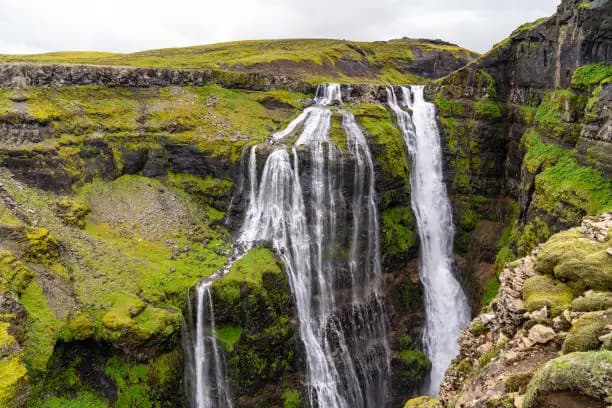
The falls plunge in two stages into a canyon with dark basalt walls. Below, the Botnsá river joins Lake Hvalvatn before flowing into the fjord. The trail hugs moss-covered cliffs, crosses lava fields, and offers vertiginous views of the canyon from the upper rim. Dense vegetation contrasts with bare rock—a landscape quintessentially Icelandic.
History and Context
Glymur means literally "roar" in Icelandic, referencing the waterfall's deep rumble. For decades it was considered Iceland's highest cascade until the discovery of Morsárfoss in Vatnajökull National Park. The surrounding fjord of Hvalfjörður served as a strategic Allied naval base during the Second World War.
Highlights of the Visit
The River Crossing
Traversing the Botnsá on a fallen log (or by fording, depending on season) is the most technical moment of the trek. It determines your access to the best vantage point on the falls. In summer, water levels are typically manageable; in spring, snowmelt can make the crossing risky.
The Upper Viewpoint
As you reach the canyon's rim, you overlook the waterfall in its full height. Views of Hvalfjörður fjord stretch away to the horizon. This is the hike's crowning moment, both physically and visually.
The Cavern Behind the Falls
A small rocky hollow nestles at the cliff base, partially hidden by spray. It allows you to approach the waterfall within metres and witness the force of falling water up close.
Photography Tips
Light is gentlest late in the day, when the low sun illuminates the canyon walls. From the upper viewpoint, a wide-angle lens captures the entire falls and fjord beyond. Lower down, near the cavern, a standard lens suffices to convey the water's power. Bring a cloth—spray reaches your lens quickly.
Location and Access
Glymur lies at the far end of Hvalfjörður fjord in western Iceland. From Reykjavík, take Route 1 north, then turn into the fjord via Route 47. The drive takes roughly 1 hour 30 minutes. No regular public transport reaches the trailhead car park. The trail begins at Botnsdalur car park and follows the river to the falls.
Nearby Attractions
- Hvalfjörður Fjord — one of Iceland's longest fjords, with mountain scenery and Second World War relics.
- Reykjavík — Iceland's capital, the natural starting point for a day trip to Glymur.
- Golden Circle — the classic route (Geysir, Gullfoss, Þingvellir) accessible from Reykjavík in the same region.
Frequently asked questions
June to September offer the most favourable conditions: the river crossing is passable and trails are clear. In May, snowmelt can make the ford hazardous. In winter, the trail is snow-covered and inadvisable without specialist equipment.
It's classed as moderate to challenging. The river crossing on a fallen log demands balance. Terrain is rocky and sometimes slippery. Waterproof hiking boots and trekking poles make the journey easier.
No, access is free. There's no admission charge or booking required.
Yes, from Reykjavík. The hike takes 3 to 4 hours; setting off early leaves time to explore Hvalfjörður fjord or return via the Snæfellsnes peninsula if you have a vehicle.
Yes, without restriction. Protect your equipment from spray, especially near the waterfall's base.
No. A rental car is essential. Some operators offer guided excursions from Reykjavík that include transport.
Interested in this visit?
We can include it in your personalised itinerary.