Golden Circle
Golden Circle
The Golden Circle connects in a single day three emblematic sites of southwestern Iceland: the tectonic rift of Þingvellir (UNESCO), the Strokkur geyser and the double waterfall of Gullfoss.
The Golden Circle is a classic tourist circuit in southwestern Iceland, connecting three major natural and historical sites: Þingvellir National Park, the Geysir geothermal area and Gullfoss waterfall. Accessible in a single day from Reykjavik, it concentrates within a few hundred kilometres rare geological phenomena and a defining moment in Icelandic history.
Quick Facts
- Access: rental car recommended; daily tourist buses and organised tours depart from Reykjavik.
- Recommended duration: one full day (8–10 hours) for the three main sites.
- Þingvellir entrance: park access free; parking fee applies.
- Geysir entrance: site access free.
- Gullfoss entrance: access free.
- Clothing: waterproof garments and sturdy footwear essential year-round.
- Accessibility: varies by site; immediate surroundings of Geysir and Gullfoss visitor centre are accessible, Þingvellir trails more challenging.
What to See
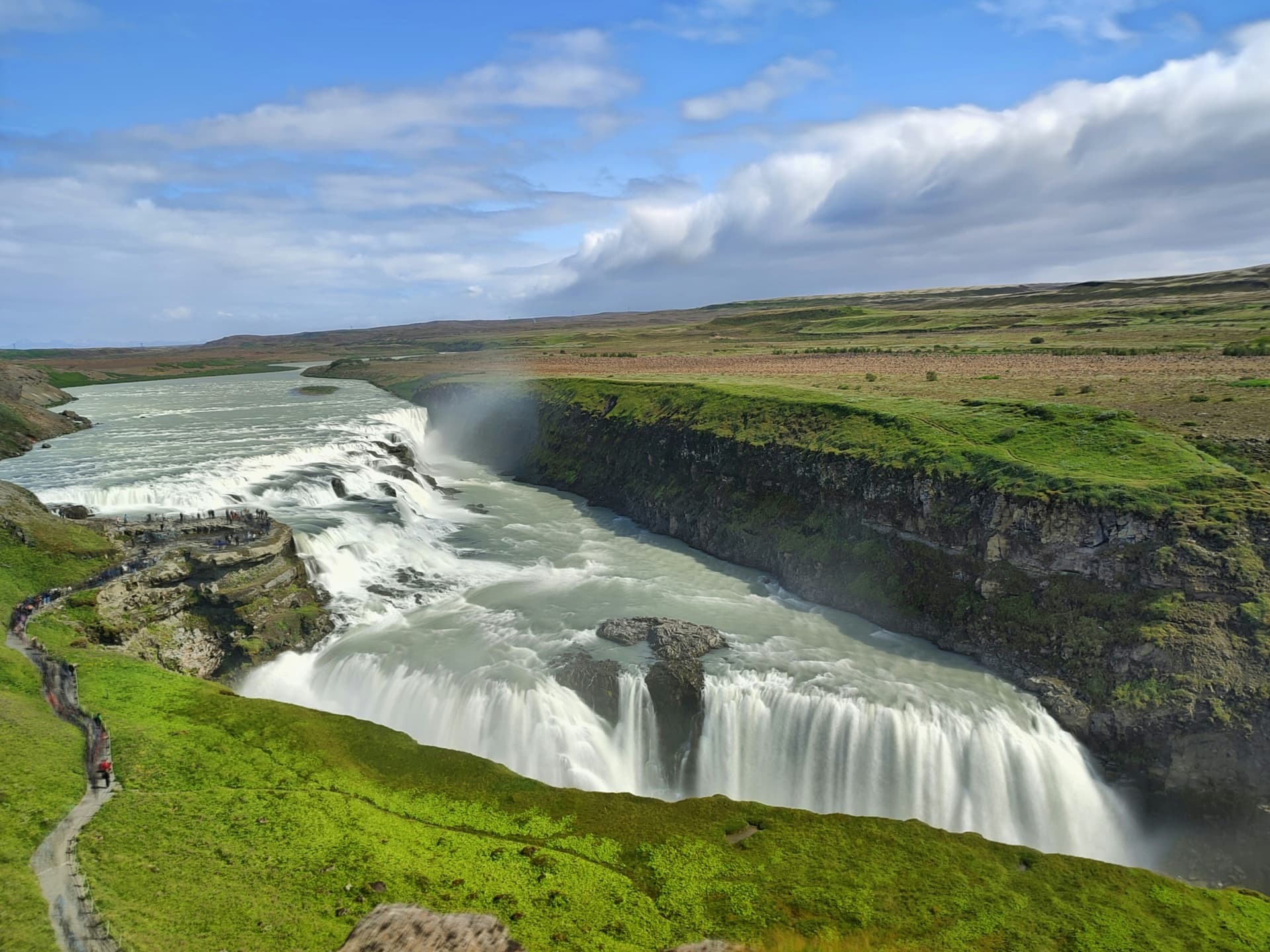
The circuit traverses three distinct environments. At Þingvellir, the visible rift between the North American and Eurasian tectonic plates creates a spectacular fracture across the landscape. At Geysir, the Strokkur geyser erupts every five to ten minutes, shooting a column of boiling water skyward. Gullfoss, a double waterfall on the Hvítá river, plunges its waters into a deep gorge.
History and Context
Þingvellir is the site of the Althing, the Icelandic parliament founded in 930 CE, one of the world's oldest democratic assemblies. It was also here that Iceland's adoption of Christianity was proclaimed in the year 1000. The site has been inscribed on the UNESCO World Heritage List since 2004. Geysir gave its name to all geysers worldwide; the eponymous geyser is now largely inactive, but Strokkur, its immediate neighbour, remains highly reliable.
Highlights of the Visit
Þingvellir: The Rift and the Althing
The path along the Almannagjá rift allows you to walk literally between two tectonic plates. The ruins of the Althing and the Þingvellir plain offer an open panorama across Þingvallavatn, Iceland's largest natural lake.
Geysir: Strokkur in Eruption
Strokkur is predictable and reliable: an eruption every five to ten minutes. The ground around the site steams constantly, dotted with mineral-coloured hot springs. Stay behind safety cordons — the water is scalding.
Gullfoss: The Double Waterfall
Gullfoss plunges in two tiers into a basalt gorge. On sunny days, rainbows form in the spray. A trail descends toward the waterfall for a closer view; expect to get splashed.
Photography Tips
For Strokkur, set your camera to burst mode and anticipate the eruption by observing the water's surface rising. Low-angle light in early morning or late afternoon showcases the Þingvellir rift beautifully. At Gullfoss, position yourself on the upper platform to frame both tiers; midday light creates the sharpest rainbows. Drones are prohibited within Þingvellir National Park.
Location and Access
The circuit typically departs Reykjavik eastward, following Route 36 to Þingvellir, then Route 365 to Geysir, and finally Route 35 to Gullfoss. The complete loop covers approximately 300 km. Local agencies offer guided excursions departing Reykjavik, with stops at all three sites. In winter, check road conditions before departing.
Nearby
- Þingvellir National Park — first stop on the circuit, UNESCO site and accessible tectonic rift.
- Geysir Geothermal Area — hot spring field and Strokkur geyser, essential second stop.
- Gullfoss Waterfall — double cascade on the Hvítá river, third circuit site.
- Secret Lagoon (Gamla Laugin) — natural geothermal pool at Flúðir, often combined with the Golden Circle.
- Kerið Crater — volcanic crater lake with red and blue waters, accessible as a slight extension of the circuit.
Frequently asked questions
Yes, the circuit is passable in winter, though road conditions can be challenging. Four-wheel drive is recommended, and you should check road conditions (vegagerdin.is) before departing. Sites remain open year-round.
One full day suffices for the three main sites. Allow eight to ten hours total, including breaks and travel time. If you wish to add Kerið or Secret Lagoon, plan a slightly longer day or depart early.
Both options work. With a rental car, you manage your own pace freely. Organised tours from Reykjavik include transport and sometimes a guide; they suit those who prefer not to drive or are uncertain about winter conditions.
Access to Geysir and Gullfoss is free. At Þingvellir, park entry is free, but parking is charged. Visitor centres with cafés exist at each site.
Strokkur erupts every five to ten minutes, regardless of season. There is no best time: the geyser is active continuously. In summer, extended daylight allows you to photograph eruptions at any hour.
Yes. Kerið Crater and the Secret Lagoon at Flúðir integrate easily into the loop. Some travellers extend south toward Vik coast or the Seljalandsfoss and Skógafoss waterfalls the following day.
Interested in this visit?
We can include it in your personalised itinerary.