Geysir
Geysir
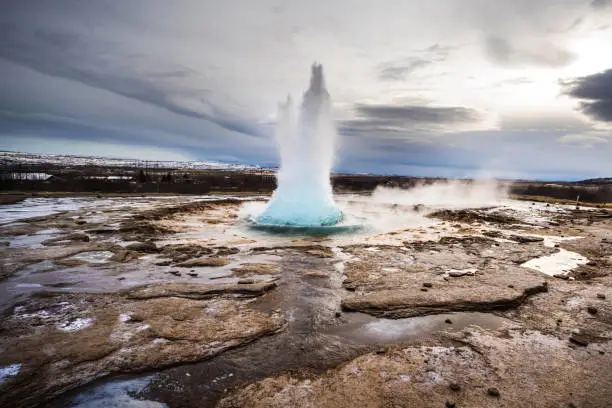
In the Haukadalur valley, Geysir gave its name to all geysers in the world. Its active neighbor Strokkur erupts every five to ten minutes, shooting water up to 40 meters high.
Geysir is the eponymous geyser that gave its name to all geysers worldwide. Located in the Haukadalur valley in southwestern Iceland, it is part of the famous Golden Circle. The site hosts several active hot springs, including Strokkur, which erupts every five to ten minutes. Geysir itself has been dormant since the early 20th century, but the geothermal power of the place remains striking.
Quick practical information
- Entrance: outdoor site access is free; paid parking on-site
- Recommended duration: 30 to 60 minutes to observe several Strokkur eruptions
- What to wear: waterproof clothing and closed-toe shoes recommended — the ground can be muddy and wet
- Rules: never approach the hot springs or throw objects into them — water reaches nearly 100°C
- Accessibility: main trails around Strokkur are wheelchair-accessible
What you'll see
The site features around a dozen hot springs with colors ranging from milky blue to translucent green. Strokkur is the main attraction: its water column rises between 15 and 40 meters depending on the eruption. The Blesi basin, divided into two pools with contrasting hues, perfectly illustrates the chemistry of geothermal waters. Fumaroles and white silica deposits dot the landscape.
History and context
The Icelandic word geysa (to gush) is the origin of the universal term "geyser." Geysir has been documented since the 13th century. Its spectacular eruptions attracted European travelers from the 18th century onward. Earthquakes have repeatedly reactivated or halted its activity; today, it remains in prolonged dormancy, leaving Strokkur to play the main role.
Highlights of your visit
Strokkur in eruption
The wait rarely exceeds ten minutes. Watch the surface of the basin dome slightly before the explosion—this bulging signals the imminent eruption. Position yourself facing away from the wind to avoid the spray of hot water.
The Blesi basin
Two pools side by side: one clear and boiling, the other opaque and bluish. The temperature difference explains the color: cooler water dissolves more silica, creating this characteristic milky effect.
The panorama from the hill
A short trail climbs behind the main site. From the summit, the Haukadalur valley stretches out with its lava fields and isolated farms. On clear days, the Langjökull glaciers are visible on the horizon.
Photography tips
Golden hour light in the early morning or late afternoon accentuates the vapor and colors of the basins. To capture Strokkur's eruption, set a fast shutter speed (1/1000 s or faster) and frame wide—the column rises quickly. Avoid standing with the sun behind you: reflections on the water look better with soft backlighting. In winter, the vapor contrasts dramatically against a dark sky, creating highly graphic images.
Location and access
Geysir is located in the Haukadalur valley, approximately 100 km east of Reykjavik via Route 35. It fits naturally into the Golden Circle route, between Þingvellir and the Gullfoss waterfalls. Tour buses connect Reykjavik to the site year-round. By rental car, allow approximately 1 hour 30 minutes from the capital. The main parking lot is large; during high season, it fills up early in the morning.
Nearby attractions
- Gullfoss — Iceland's most famous two-tiered waterfalls, a few kilometers to the northeast.
- Þingvellir — site of Iceland's first parliament and visible rift between the Eurasian and North American tectonic plates.
- Kerið — red volcanic crater with turquoise waters, approximately 45 km to the southwest.
- Geysir Center exhibition hall — museum and visitor center adjacent to the site, useful for understanding local geology.
Frequently asked questions
Strokkur erupts on average every five to ten minutes. Wait times are therefore short; plan to stay at least 20 minutes to see several eruptions.
Yes, the outdoor site is open permanently. In winter, Route 35 is generally passable, but check weather conditions before departing—snowstorms can close roads.
This is the classic Golden Circle route, feasible in one day from Reykjavik. Start early to avoid crowds at Geysir mid-morning.
There are no photography restrictions on the site. Simply remain behind safety cordons to avoid damaging silica deposits and to avoid hot water spray.
Waterproof clothing and closed-toe shoes are essential. Wind can spray hot water droplets, and the ground around the basins is often wet and slippery.
Geysir has been dormant since the early 20th century. Earthquakes have briefly reactivated it in the past, but today it is Strokkur, just a few meters away, that produces the regular eruptions visible now.
Interested in this visit?
We can include it in your personalised itinerary.