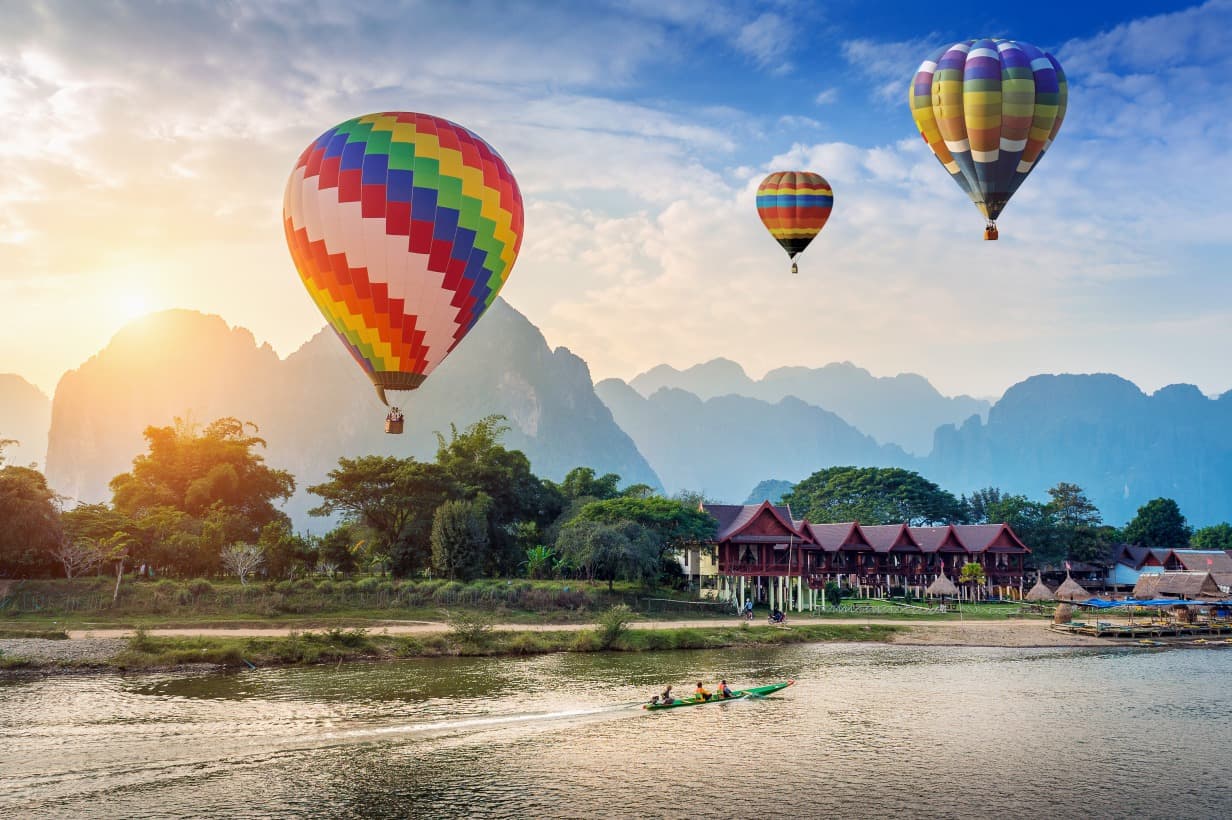
Vang Vieng
Vang Vieng
Between spectacular karst mountains and the Nam Song River, Vang Vieng has reinvented itself as Laos's premier nature and adventure destination. Our complete guide.
A trip to Laos practically demands a stop in Vang Vieng: whether you're drawn to raw nature and picturesque landscapes or you're a thrill-seeker craving adventure and an Ibiza-like atmosphere, Vang Vieng is undeniably a place where everyone finds their perfect match.
A two-faced town nestled on the banks of the Nam Song River, it captivates for two very different reasons: the breathtaking backdrop of karst mountains towering above the river, and its vibrant, touristy energy. True, the downtown area lacks charm in many respects, yet the local activities are exhilarating and invigorating for anyone willing to try them: caving, rock climbing, tubing, trekking, kayaking and rafting, and more.
Far more touristy than most Laotian towns, Vang Vieng draws crowds during the dry season—when tourism peaks. Still, it's entirely possible to retreat and unwind away from the hustle and bustle in the surrounding countryside.
History
This northern Laotian town was established in 1353 as a waypoint between Luang Prabang and Vientiane. Originally known as Mouang Song, it wasn't until 1890 that it received the name Vang Vieng, coinciding with the establishment of the French protectorate over the country.
Its economic development was marked by several growth spurts. The first came during the Vietnam War, between 1964 and 1973, when Air America established one of its major airbases here: Lima site 6. It's believed CIA operations used this airfield for covert missions. By the 1990s, the town experienced a second major boom with the arrival of young Western backpackers. They came from far and wide to admire the stunning, untamed natural beauty and seek thrilling adventures. Local tourism exploded.
However, this enthusiasm was tainted by the arrival of Vietnamese and Chinese investors in the early 2000s. They transformed the region into a "Asian Cancun"—a tourism cancer. The town became a place where all manner of drugs circulated freely. Streets filled with partying backpackers. The result: over 20 foreign tourists died here in 2011. Facing scrutiny, local authorities took action. In 2012, they banned drug sales and consumption, shut down illegal bars, and imposed a strict 11 p.m. curfew.
These drastic measures allowed local tourism to bounce back and rehabilitate the town's image.
Today
Now part of Vientiane Province, Vang Vieng continues to reinvent itself. The days of drunken crowds filling the streets are long gone. It's become noticeably more sober and peaceful, a place where walking and cycling are genuinely pleasant. Today it radiates a healthier, less exuberant good cheer among its visitors.
The downtown area has an old-world charm. That said, it's lovely to visit the morning market and calmly enjoy views of the surroundings. Vendors occasionally sell remarkable folksy products: fried squirrels, roasted insects, grilled rat skewers—an invitation for culinary adventurers.
Vang Vieng is home to vast rice paddies, striking limestone karst mountains, curious rural villages, mysterious caves, and mesmerizing turquoise lagoons.
For adrenaline junkies, the area offers tubing down the Nam Song River, climbing the sheer cliffs of karst formations, trekking through wild terrain, hiking, kayaking on the Nam Song or Nam Ngum rivers, hot air balloon rides over the region, canoe excursions, and more.
Its festive scene also caters to younger visitors: dance floors by riverside bars, happy hours, ladies' nights, drinks galore, fast food, and various activities (mud baths and beach volleyball, zip-lining, water slides, wet basketball, etc.). Western-style vacations in Asia, in other words.
Among the attractions that built its reputation are:
- exploring the Tham Sang Triangle
This cave complex sits 10 kilometers from town. It features the Tham Sang grotto with its unusual stalactite shaped like an elephant and numerous Buddha statues; the quirky Tham Nam (water cave) accessible by tubing; Tham Hoi (snail cave); and Tham Loupavec with its underground river and towering guardian Buddha. Curious natural treasures hide within: intricate stalactites and stalagmites, Buddhist figurines, and other wonders worth the visit.
- tubing
A genuine thrill, floating down the Song River in a tractor tire tube is one of Vang Vieng's signature activities. Tube rental costs 50,000 kips and is valid only until 6 p.m. Given Laos's scorching days, this adventure is perfect for cooling off, relaxing, and savoring the scenery.
- hot air balloon rides
Ascending into the clouds offers a stunning panorama of the entire town. This elevated perspective showcases the area's magnificence. Not for every budget, a 45-minute balloon ride costs a minimum of 80 euros.
Climate and Geography
This northern Laotian town borders the Nam Song River and lies between Luang Prabang and the capital, Vientiane. More precisely, it sits approximately 155 kilometers from Vientiane via Route 13, which connects the two cities, nestled between the river and the old airstrip.
Two main streets define the layout: one runs along Nam Song, the other branches into small alleys. To the west of the river stretch the countryside, caves, and karst formations. Visiting these areas requires crossing the water via a bamboo toll bridge at Vang Vieng's south end (crossing fee: 10,000 kips round-trip). During the rainy season, a ferry operates instead.
This Laotian town has a savanna climate with a dry winter, like the rest of Laos. The peak tourist season coincides with the dry season, November through March. It's warm but bearable. This period is ideal for hiking, water sports, and climbing. Between March and May, temperatures soar above 40°C (104°F).
To reach Vang Vieng, only overland travel is viable—the airfield has been out of service for years. Several options exist: buses, minibuses, rental cars, minivans, etc. Costs and transportation types vary depending on your starting point. Bus or minibus fares typically run $10, though prices fluctuate.
- From Vientiane
One-way options include non-air-conditioned buses (40,000 kips) or comfortable VIP buses (60,000 kips). Alternatively, minivans cost between 70,000 and 80,000 kips per person. Car rental from the capital is also worthwhile.
- From Luang Prabang
Choose between VIP buses, Express buses, and minibuses. A flat rate applies to VIP buses (130,000 kips) and Express buses (110,000 kips) serving Luang Prabang and Vientiane. Taking either to reach Vang Vieng means paying that fare and getting off halfway. Minibus or minivan trips run 100,000 kips ($10).
- From Udon Thani in Thailand
A direct bus for a one-way trip costs 88,000 kips. Passengers can handle visa details at the land border crossing.
- From Phonsavan, in Xiengkhuang
Day bus tickets cost 110,000 kips; night buses, 150,000 kips. A minibus also runs daily for 100,000 kips per seat.
Typically, each journey terminates either in Vang Vieng's downtown or at the old airfield, a two-minute walk from the main street.
- On foot
Walking lets you quickly explore and reach the lively bars and restaurants along the river.
- By motorcycle, bicycle, or scooter
Most of Vang Vieng's main attractions lie outside the town proper. These two-wheeled vehicles are perfect for covering the distance between the dreary town center and its surroundings. Renting a manual scooter for a half-day (7 a.m. to 8 p.m.) costs 40,000 kips. A full day is 70,000 kips. Automatic models run 50,000 kips for a half-day and 90,000 kips for a full day. Bicycles rent for 10,000 kips per day, motorcycles for 30,000 kips.
Practical Information
Before you arrive in Vang Vieng, here's what to know:
The town has ATMs and a branch of the BCEL bank. Withdrawals are capped at 1,000,000 kip. You can exchange currency at select travel agencies and guesthouses at fair rates.
Most hostels and hotels offer complimentary 3G Wi-Fi.
The Hobo Map of Vang Vieng is available at local shops or Monuments Books in Vientiane. It clearly shows routes and must-see spots.
After tubing, wear decent clothes rather than beach attire when walking around town.
What to Do?
- Climb Pha Ngern Mountain and take in the horizon
- Visit Tham Jang Cave (or Tham Chang) first, with its 147 steps, crystal spring water, and sweeping valley views
- Explore the Tham Sang Triangle thoroughly
- Wander through Tham Pukham Cave, cool off in its turquoise-green lagoon, and discover its reclining bronze Buddha statue
- Enjoy a cold beer on the Nam Song banks while savoring karst views
- Book a hiking or trekking expedition into the hills and cave depths
- Join the quirky, playful activities at Nam Song's riverside bars
- Swim in the Song River during the dry season or cross it by canoe
- Visit the countryside and remote villages to experience local life
- Stop by the serene organic farm 4 kilometers north of town
- Experience the thrills of tubing, kayaking, caving, climbing, and a hot air balloon ride
- Admire the beauty of its ancient 16th and 17th-century monasteries
Want to discover this destination?
Our local advisors design your tailor-made trip.