Vientiane
Vientiane
A serene capital on the banks of the Mekong, Vientiane blends golden temples, French colonial heritage, and a gentle way of life. Our guide for 2 days on the ground.
Vientiane has long been overlooked by travelers in favor of destinations with richer heritage like Luang Prabang. Yet this Laotian capital merits a detour of one or two days for its admittedly provincial and tranquil atmosphere, as well as its modest collection of historical and religious monuments. Marked by architecture that is alternately French and Soviet, its city center remains a charming stop. A perfect pause for those weary of the chaos of major cities and those wishing to savor the meanders of the Mekong.
History
Originally, Vientiane—literally translated as "Port of the Moon"—derives from the name "Vienkham," which means "gate or wall of gold." A claimant to the Laotian throne wished to besiege the city, but the ramparts, constructed from substantial bamboo pikes, prevented a frontal assault. To forge a path, he ordered his archers to coat their arrows with gold and fire them at the bamboo barriers for three days. After the troops withdrew, inhabitants emerged from the fortress to gather the gold. But their greed sealed their fate: the trap closed upon them and the city fell under the rule of its new king. He christened it "Vienkham."
Vientiane officially came into being in 1560 when King Setthathirath granted it the status of capital of the Kingdom of Lan Xang.
Thereafter, the city witnessed numerous confrontations and enemy assaults. Between 1570 and 1574, it endured its first Burmese attack. In 1707, it became an independent city as the Kingdom of Vientiane following the collapse of the Kingdom of Lan Xang. After the second Burmese plunder in 1774, General Phraya Chakri (Rama I) made the city a Siamese dependency.
It was in 1899 that the region transitioned under the French protectorate of Laos, becoming its capital. Nevertheless, the earliest traces of French civilization date back earlier, to 1867, when explorers came to rebuild and occupy the city. Grand houses and buildings with colonial architecture emerged, though the scale of construction was more modest than in the major cities of French Indochina.
It was not until the 2000s that a rapid surge of development was observed in this region of Laos. A boom that took root with the 10th ASEAN summit (Association of Southeast Asian Nations) in November 2004, with the 25th Southeast Asian Games in December 2009, and with celebrations of its 450th anniversary in November 2010.
Vientiane Today
Strolling through the city's narrow streets, one encounters both the hallmarks of French Indochina and echoes of Russian socialist influence. Indeed, several houses, villas, and buildings stand in the colonial style of the French metropolis, such as the Church of the Sacred Heart. Vientiane also features structures inspired by Soviet architecture, as seen in Nam Phu. And within this Franco-Russian melange, buildings with an "international" character dot the landscape here and there, notably the Don Chan Palace.
The city's magic also flows through its numerous monuments. Patuxai, Laos's answer to Paris, this "triumphal arch" echoes the image of the one on the Champs-Élysées—the similarities are striking. Other monuments worth seeing include the black stupa, or That Dam, and the imposing statue of King Anouvong.
In Vientiane, each neighborhood has its own temple: Vat Ong Theu, Vat In Peng, Vat Mixai, and Vat Phia Vat with its great Buddha. But among the most majestic are:
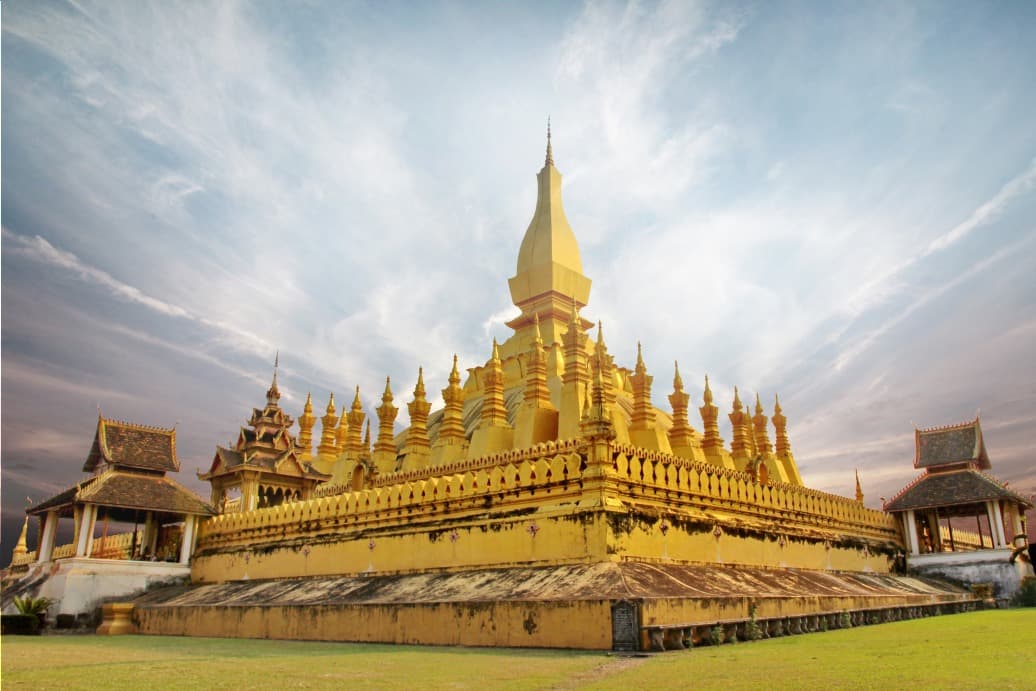
- the magnificent Pha That Luang, or the great golden Stupa: unmissable, this gold-covered temple is the symbol of Buddhist faith and national sovereignty.
- the revered Vat Si Muang: believed to house the protective spirit of the city and bring good fortune to worshippers, this monastery is the venue for the annual Boun That Luang festival each November.
- the Vat Sisakhet on Setthathirat avenue: 10,000 Buddhas are housed here, including one that, according to legend, grants all wishes.
- the Vat Phra Kaeo: a pagoda rebuilt in 1936, it stands out for its numerous Buddhist religious artworks.
For those seeking cultural offerings, there are two destinations: the National Museum of Laos, which chronicles the country's history, and the Kaysone Phomvihane Museum, dedicated to Laos's second president.
Laos's capital is also defined by its morning market, the Talat Sao, and its evening market on the banks of the Mekong. The Talat Sao remains a pleasant bazaar where you can find anything: textiles, jewelry, tools, televisions, electronics, food, and more. It's ideal for creating souvenirs and finding treasures.
Climate
Situated on the left bank of the Mekong River, Vientiane is a small city no larger than Toulouse. Blessed with a tropical climate, it experiences heavy precipitation during the summer season. This means that between June and September, it's best to avoid the region. The best periods, with little rain and plenty of sunshine, fall between November and February.
The capital records an average annual temperature of 25.4°C and precipitation of 1,622mm.
From France, there is but one way to reach the heart of Laos: by plane. Nevertheless, airline routes can vary: with Thai Airways, Malaysia Airlines, Finnair, and others. All make stops in countries and cities bordering Laos (Bangkok, Kuala Lumpur, etc.) before serving Wattay International Airport. However, none operate direct flights from metropolitan France.
A helpful tip: save money by taking only a one-way flight to Bangkok. Then, purchase a ticket to Vientiane once you arrive. This alternative often proves cheaper than a standard flight from Paris.
Also, the bus is a practical and quick way to reach the capital from other Asian countries. Departing from Bangkok, you can access it by land in various ways: VIP bus, train, and minibus.
From one monument or temple to another, there are several ways to get around:
- by bicycle:
This two-wheeled vehicle is the perfect solution for wandering through the capital, especially since traffic in Vientiane is light.
- by scooter or motorcycle:
Renting a motorcycle or scooter is surprisingly affordable here: ideal for weaving through alleys and getting around quickly. Just watch out for the spirited local drivers.
- on foot:
The best way to enjoy the city remains walking tours. And given the small size of the region, distances to cover are relatively short. Do remember to bring an umbrella and a bottle of water to protect yourself from the sun.
- by car:
Certainly, a car is the most expensive option, but it's appreciated for its convenience and comfort. Renting one with a driver is recommended, especially if they know the area well.
- by tuk-tuk:
For authenticity, look no further—but know how to negotiate well. The quoted fares can be surprisingly exorbitant. Otherwise, opt for cheaper alternatives: a shared tuk-tuk or jumbo.
- by bus:
Bus travel is the cheapest and fastest way to cover long distances, such as the 20 km between the city center and Buddha Park. Pick one up roadside or at a station.
Pre-Visit Advice
Enjoy certain Vientiane monuments requires some preparation. To visit Pha That Luang, women must wear long pants or a long skirt with covered shoulders.
For those fond of evening strolls along the Mekong River, know that Laotian authorities prohibit them. There is a curfew to respect.
And one final piece of advice: watch out for pickpockets and scammers. Despite its peaceful character, Vientiane unfortunately has a few.
What to Do?
- visit Patuxai and from its summit, admire the magnificent panorama over the city
· 20 kilometers from the city center, discover the peculiar statues at Buddha Park or "Vat Xieng Khouane" while taking in views of the Thailand-Laos Friendship Bridge
- embark on a tour of Vientiane's Buddhist temples
- see with your own eyes the golden sanctuary Pha That Luang and perhaps attend the That Luang celebration in November
· visit the COPE museum (Cooperative Orthotic and Prosthetic Enterprise) exhibiting the devastation of the Vietnam War
- in the morning, shop the stalls of Talat Sao; in the evening, explore the artisanal market on the banks of the Mekong
· at sunset, savor grilled dishes and Beerlao along the Mekong River
· try Laotian gastronomic experiences (spicy or mild) with tom yam, grilled meats, spring rolls, and more
· disconnect for a moment from Vientiane's peaceful atmosphere with an aperitif by the river or a night out at a downtown nightclub (Novotel, Lucky Music, etc.)
- make a trip to Chao Anouvong Park
Want to discover this destination?
Our local advisors design your tailor-made trip.