Hofsjökull
Hofsjökull is Iceland's third-largest glacier, a dome of ice perched on an active volcanic caldera deep within the Highlands. Accessible only by 4×4 in summer, it is visited exclusively on guided expeditions.
Hofsjökull is Iceland's third-largest glacier and the country's largest active volcanic caldera beneath ice. Located in the heart of the Highlands, it covers approximately 925 km² and rises above 1,700 meters. Completely isolated, it can only be visited on organized expeditions, making it terrain reserved for seasoned adventurers and lovers of raw Arctic landscapes.
Quick facts
- Access: F-roads only (Highlands), passable in summer with a high-clearance 4×4; F-roads are closed in winter.
- Recommended season: July to early September, when Highlands roads are open.
- Suggested duration: a full day minimum from a base such as Kerlingarfjöll or Hveravellir; multi-day expeditions to explore glacier margins.
- Guidance: progression on ice requires a certified guide and glacier equipment (crampons, rope, ice axe).
- Accessibility: not wheelchair accessible.
What you'll see
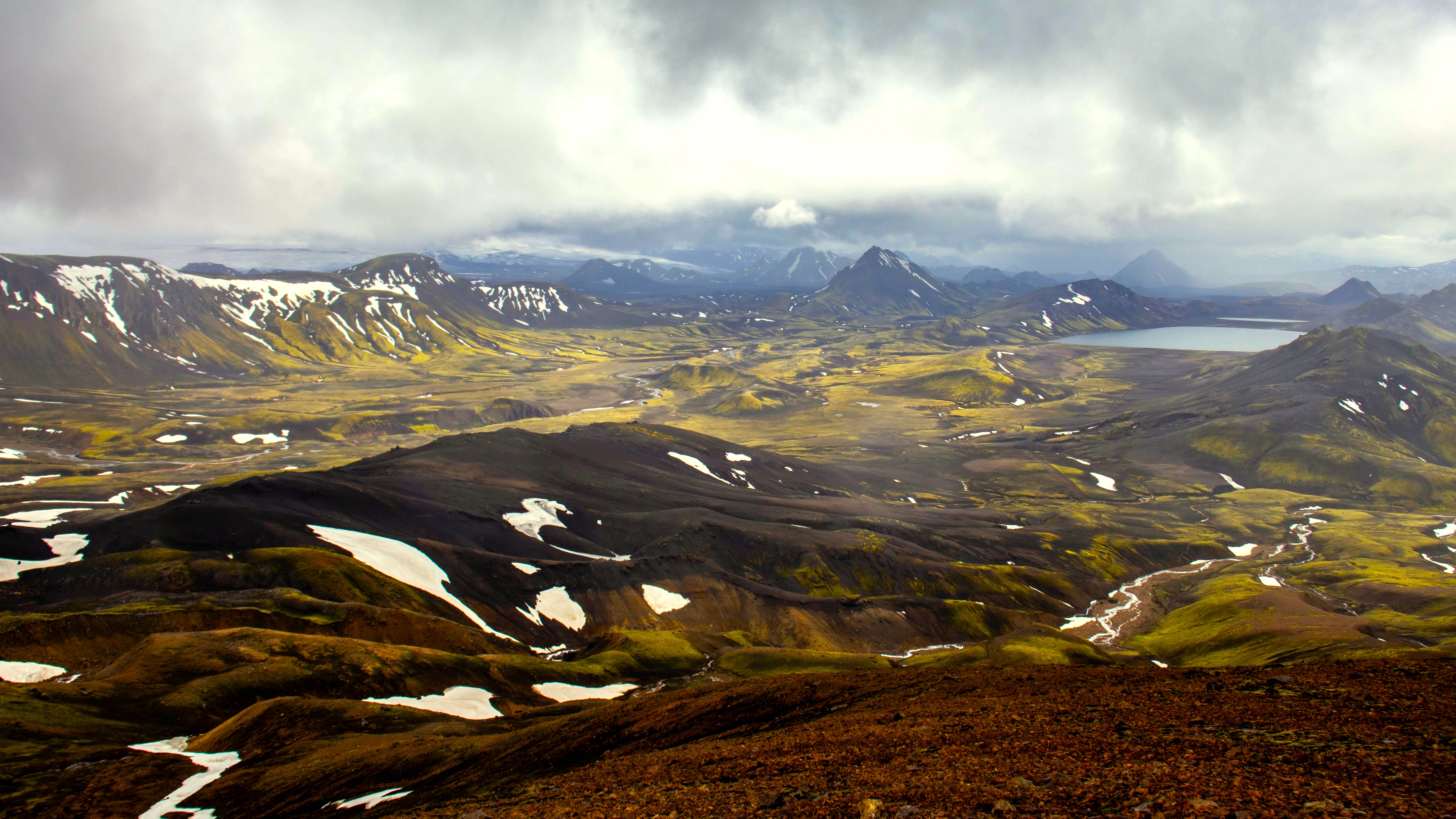
Hofsjökull presents itself as an almost perfectly symmetrical dome of ice, scored by crevasses and glacial tongues descending toward volcanic sand plains. The central caldera, buried beneath hundreds of meters of ice, is a reminder that the glacier rests on an active volcano. The glacier's margins reveal recent moraines, milky-hued proglacial lakes, and unpredictable meltwater rivers.
History and context
The name Hofsjökull literally means "temple glacier" in Icelandic. Like most Icelandic glaciers, it has retreated measurably since the early twentieth century due to climate warming. Icelandic glaciologists monitor it regularly: the underlying volcanic caldera, should it erupt, could trigger a jökulhlaup — a sudden and devastating glacial flood — affecting surrounding rivers such as the Þjórsá.
Highlights of the visit
Glacial tongues and moraines
The glacier fronts accessible from F-roads allow close observation of blue ice texture, moraine deposits, and small meltwater lakes. This is where glacial dynamics are most clearly legible, without technical equipment.
Panoramas from surrounding ridges
From the heights of Kerlingarfjöll to the southeast, Hofsjökull's white dome dominates the Highlands horizon. On clear days, the view also encompasses the glaciers Langjökull and Vatnajökull in the distance.
Guided traverse across the caldera
With a certified guide, it is possible to progress across the summit plateau. The experience—absolute silence, total whiteness, awareness of walking atop an active volcano—is difficult to match in Iceland.
Photography tips
Raking light from late evening in summer (midnight sun) accentuates ice relief and tints moraines in warm ochre. From F-roads, proglacial lake reflections offer effective foregrounds. Avoid full sun hours: ice overexposes easily. A polarizing filter is useful for reducing reflections on meltwater.
Location and access
Hofsjökull lies at the geographical center of Iceland, in the Highlands. The F-roads enabling approach to it depart notably from route F35 (Kjölur), which links Gullfoss to the north of the country. The geothermal camp Hveravellir is a natural logistical base, situated on F35 in relative proximity to the glacier. The Kerlingarfjöll massifs, accessible via F347, offer a viewpoint and mountain hut accommodation. No public transport serves the Highlands.
Nearby attractions
- Hveravellir — geothermal oasis on the Kjölur route, with hot springs and mountain hut, ideal as a stopover before or after the glacier.
- Kerlingarfjöll — rhyolitic massif with vivid colors, fumaroles, and spectacular hikes in the Highlands.
- Langjökull — Iceland's second-largest glacier, more accessible, featuring a visitable glacier tunnel on organized excursions.
- Gullfoss — major Golden Circle waterfall, southern departure point of the Kjölur route.
Frequently asked questions
Approach by 4×4 vehicle to glacier margins is possible without a guide. However, any progression on ice—even at the edges—requires professional supervision and appropriate glacier equipment due to crevasses.
Highlands F-roads typically open in July and close in September, depending on that year's snow conditions. Check road conditions on the Icelandic Road Administration website (Vegagerðin) before departure.
A high-clearance 4×4 is essential. F-roads include glacial river crossings whose levels vary with daily melt. A standard passenger car is entirely unsuitable and prohibited on these roads.
Yes. Kerlingarfjöll is located on F347, a branch of F35. The two sites combine naturally over a two- to three-day stay in the central Highlands.
The caldera beneath Hofsjökull is continuously monitored. In case of eruptive alert, Icelandic authorities close access. Consult the Icelandic Meteorological Office (Veðurstofa) website for volcanic bulletins before any expedition.
Interested in this visit?
We can include it in your personalised itinerary.