Lagarfljót
A long glacial lake in eastern Iceland, Lagarfljót is renowned for its milky waters, the Hallormsstaðarskógur forest, and the medieval legend of Lagarfljótsormur, its legendary giant serpent.
Lagarfljót is a long glacial lake in eastern Iceland, situated a few kilometres from Egilsstaðir. Carved by glaciers and fed by waters from Vatnajökull, it stretches for approximately 53 km through the Fljótsdalur valley. Its milky hue, caused by glacial sediment, lends it a distinctive character. The lake is primarily known for the legend of Lagarfljótsormur, a giant serpent said to inhabit its waters since the Middle Ages.
Key Information at a Glance
- Access: Route 1 (Ring Road) runs along the western shore from Egilsstaðir northward.
- Entry: free access; outdoor natural site.
- Recommended duration: 1 to 2 hours to explore the shores and stop at viewpoints.
- What to wear: warm and waterproof clothing recommended; winds can be strong.
What You'll See
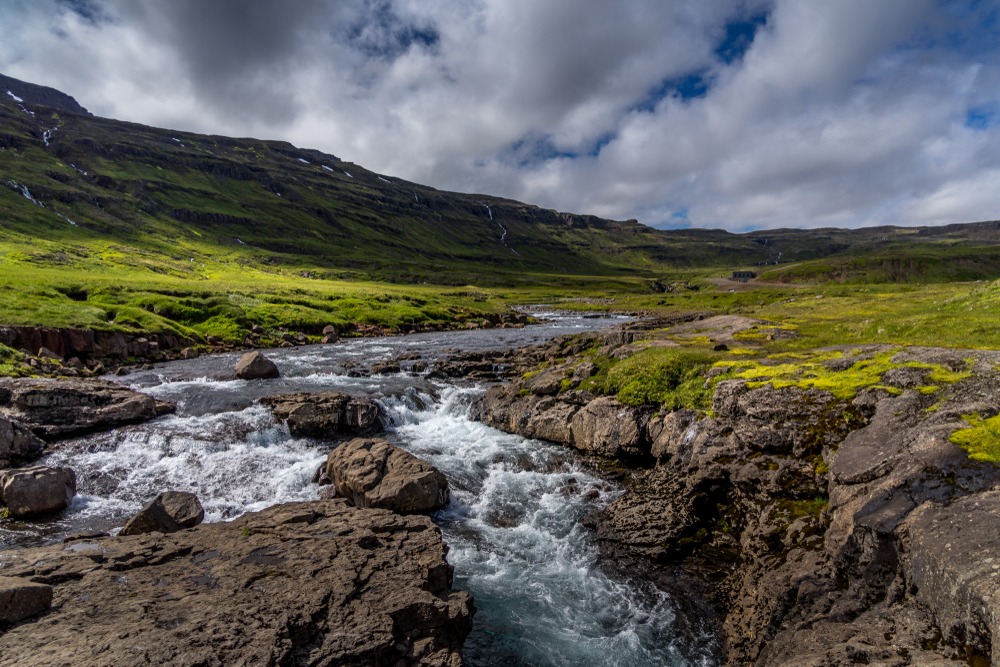
The lake displays waters of a characteristic milky grey-green typical of Icelandic glacial lakes. The shores are lined with birch and spruce trees — Hallormsstaðarskógur forest, on the eastern shore, is Iceland's largest forest. In the background, snow-capped mountains and glacial tongues from Vatnajökull close the horizon.
History and Context
The legend of Lagarfljótsormur dates back at least to the 14th century: a young girl supposedly placed an earthworm on a gold ring to make it grow, but the worm became a monster and was cast into the lake. Alleged "sightings" have been reported through to the present day. In 2012, a video claiming to show the creature went viral worldwide, but was never authenticated.
Highlights of Your Visit
Hallormsstaðarskógur Forest
On the eastern shore of the lake, this forest planted in the 20th century is unique in Iceland for its scale. Marked trails allow for leisurely walks through it. The contrast between the trees and Iceland's volcanic landscape is striking.
The Fljótsdalur Bridge
A bridge spans the lake at its southern end, offering an unobstructed view across the entire expanse of water. It is one of the best locations to photograph the reflections and milky colour of the waters.
Hengifoss and Litlanesfoss
At the northern end of the lake, a hiking trail leads to Hengifoss waterfall, one of Iceland's tallest, and to Litlanesfoss, framed by basalt columns. The trailhead is located on the eastern shore.
Photography Tips
Low-angle morning or evening light brings out the milky colour of the lake and reflections of the mountains. The southern bridge offers symmetrical framing. In autumn, the birches of Hallormsstaðarskógur turn yellow and orange, creating a rare contrast in Iceland.
Location and Access
The lake begins a few kilometres south-west of Egilsstaðir, the main urban centre of eastern Iceland. Route 1 runs along the western shore. The eastern shore is accessible via Route 931. Egilsstaðir has an airport with connections to Reykjavik. There is no regular public transport along the lake: a rental vehicle is necessary. Access to the shores is generally passable in a standard car outside of winter.
Nearby Attractions
- Hengifoss — waterfall with layers of red and black basalt, accessible by a 2-hour hike from the northern shore of the lake.
- Litlanesfoss — waterfall framed by hexagonal basalt columns, on the same trail as Hengifoss.
- Hallormsstaðarskógur — Iceland's largest forest, on the eastern shore, with walking trails.
- Egilsstaðir — stopover town in eastern Iceland, the departure point for exploring the region.
Frequently asked questions
Summer (June–August) guarantees access to all roads and very long daylight hours. Autumn offers the colours of Hallormsstaðarskógur forest. In winter, secondary roads may be closed.
Yes, the Hengifoss trail departs from the north-eastern shore of the lake. Allow an additional half-day for the round trip.
Route 1 (western shore) is asphalt and passable in a standard car. Route 931 (eastern shore) is a rough track; in summer, a standard vehicle usually suffices, but check conditions before you go.
The water is extremely cold due to its glacial origin. Swimming is not practised and is discouraged.
Egilsstaðir, a few kilometres away, concentrates the region's hotel offerings. More rural options exist in the valley, but their availability varies by season.
Interested in this visit?
We can include it in your personalised itinerary.